Prop firm marketing is the set of digital marketing and brand-building activities used to grow a proprietary trading firm and attract qualified funded traders. Prop firm marketing focuses on credibility signals such as transparent rules, payout proofs, trader education, and consistent messaging across ads, SEO, and social channels.
Prop firm marketing has become a requirement because the funded trader market has become crowded and highly competitive. Search interest in “funded trader program” has more than doubled since 2021, and the proprietary trading market is projected to grow at a CAGR of 9% from 2023 to 2030.
Marketing solutions for prop firm owners include paid acquisition, content marketing, community building, conversion-focused websites, and compliance-checked copy. Prop firm owners improve growth outcomes when prop firm marketing strategy matches the firm stage, budget, and target regions, because each channel produces different costs per challenge acquisition and different retention profiles.
Readers can use this guide to learn the best prop firm marketing strategies, practical ways to improve campaign performance, mistakes to avoid during a prop firm marketing campaign, and steps to build a recognizable prop firm brand. The same guide explains how to select marketing channels that protect return on ad spend and support long-term trader retention.
What is prop firm marketing?
Prop firm marketing is the marketing discipline that attracts, converts, and retains traders for proprietary trading firms. Prop firm marketing targets traders who buy evaluation challenges, attempt to pass challenge rules, and continue purchasing or scaling accounts after payouts.
Marketing, in a financial-services context, is the strategic promotion of regulated offers to defined audiences to drive awareness, qualified leads, and compliant conversions.Prop firm marketing is necessary due to prop trading industry growth because competition rises as demand rises.
Return on ad spend (ROAS) becomes the core performance constraint because paid ads and influencer traffic carry direct costs. Prop firms protect marketing ROI by tracking cost per challenge acquisition and repeat purchase rates, and many growth-stage firms allocate about 20–35% of revenue to marketing to maintain predictable acquisition at scale.
Why is marketing important for prop firms?
Prop firm marketing is important for prop firms because competition for funded traders keeps rising. Search interest for “funded trader program” “prop firms” “funded trader account” is growing exponentially, which increases the number of firms competing for the same demand pool.
Prop firm marketing improves visibility in search engines, social platforms, and affiliate channels, where traders compare rules, payouts, and reviews before buying a challenge. Prop firm marketing strengthens trust signals through transparent messaging, educational content, and compliance-safe claims, which reduces skepticism after major industry failures and firm closures. Prop firm marketing connects acquisition metrics to unit economics by tracking cost per challenge acquisition, repeat buyer rate, and community engagement, which supports sustainable growth in the prop trading industry.
What is prop trading industry?
The prop trading industry is the market of proprietary trading firms that fund traders to trade the firm’s capital. Modern retail prop firms require an evaluation or “funded trader program” challenge before a trader receives a funded account.
Emerging prop trading industry types focus on trader longevity and program credibility. Common emerging models include skill-based evaluations that reward consistency over speed, institutional career-focused tracks, and platforms that prioritize trader iteration, coaching, and mental health support. Many prop firms pair these models with transparent rules, clear payout terms, and published pass-rate expectations to build trust with traders.
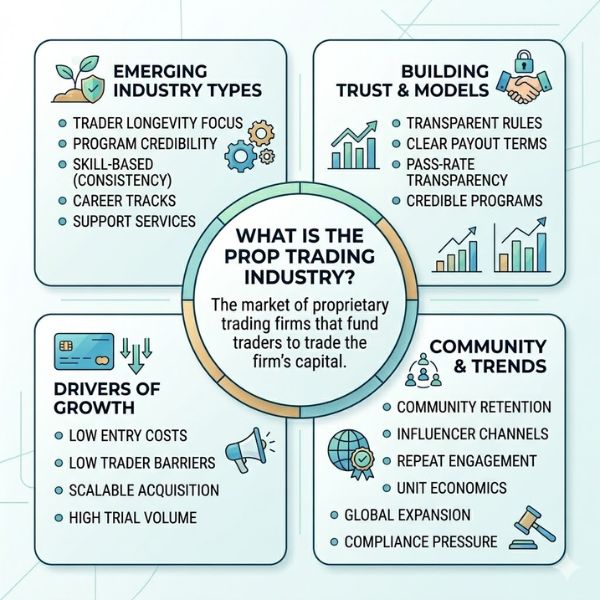
Prop trading industry growth comes from low entry costs and scalable digital acquisition funnels. Many retail prop firms price challenge fees around $100–$300, which lowers the barrier for new traders and increases trial volume. Community-led retention through Discord, social media, and influencer channels increases repeat purchases and program engagement, which strengthens unit economics for prop firms
Prop trading growth trends show geographic expansion and higher compliance pressure. High-engagement regions include Latin America (LATAM), the Middle East and North Africa (MENA), and Southeast Asia, where prop firms frequently scale community and influencer distribution. Regulatory scrutiny on “fast money” claims increases, so winning prop firms anchor marketing claims in verified data and compliance-checked messaging
What are the statistics about the prop firm industry?
Prop firm industry statistics describe demand, growth rate, operating benchmarks, and marketing economics for proprietary trading firms. The most important prop firm statistics focus on search demand, market CAGR, pass rates, payout ratios, and marketing budgets.
-
Search demand growth: Search interest in “funded trader program” has more than doubled since 2021, signaling rising demand for funded accounts.
-
Market growth forecast: The prop trading market is projected to grow at a 6.5% CAGR through 2030.
-
Marketing budget share: High-growth prop firms allocate 20–35% of revenue to marketing during scaling periods.
-
Monthly marketing budgets by stage: Launch budgets tend to sit at €6k–€20k per month, scale budgets tend to sit at €20k–€80k per month, and leadership budgets can reach €80k–€250k+ per month.
-
Annual marketing spend pattern: Global leaders can reach seven figures per year in marketing spend when operating at multi-region scale.
-
Sustainability benchmarks: Sustainable prop firm models target a pass rate below 25% and payouts below 40% of revenue to protect unit economics.
-
Data scale used for benchmarking: Industry rule design and performance modeling reference analysis across 10+ million trading accounts.
-
Geographic growth regions: High-engagement expansion regions include LATAM, MENA, and Southeast Asia, which influences localization and paid media planning.
-
Acquisition economics reference point: Many prop firms price evaluations at $100–$300 challenge fees, which shapes CAC targets and funnel conversion rates.
What are the marketing solutions for prop firm owners?
Marketing solutions for prop firm owners are channel-specific services that attract, convert, and retain traders through compliant messaging, credibility signals, and measurable acquisition funnels. Prop firm marketing solutions focus on lowering cost per challenge acquisition and improving trader lifetime value across paid and organic channels.
-
Marketing advertising solutions for prop firms: Advertising solutions build multi-channel campaigns that promote challenge offers, payout terms, and rule transparency using verified claims and compliance-checked creatives.
-
Social media management for prop firms: Social media management grows trader trust through educational posts, community engagement, and public proof such as testimonials and payout stories. Social platforms include YouTube, TikTok, X (Twitter), Instagram, and Discord for community-led retention.
-
Meta ads for prop firms: Meta ads use Facebook and Instagram targeting to reach traders by interests, behaviors, and lookalike audiences tied to challenge purchasers. Meta ad optimization improves funnel metrics through creative testing, landing page alignment, and compliance-safe financial promotion language.
-
Influencer marketing for prop firms: Influencer marketing partners with trading educators, YouTube creators, and TikTok streamers who demonstrate challenge workflows and funded account experiences.
-
Prop firm SEO marketing: Prop firm SEO marketing increases organic traffic by answering high-intent queries about funded trader programs, prop firm rules, payouts, and pass rates.
-
Google paid ads for prop firms: Google paid ads capture high-intent demand from traders searching for “prop firm challenge,” “funded account,” and brand comparison keywords. Google Ads performance improves when ad copy matches transparent landing pages that explain rules, payouts, and evaluation steps.
-
Email marketing for prop firms: Email marketing for prop firms retains traders through segmented onboarding, challenge reminders, payout updates, and reactivation sequences for repeat purchases. Email automation supports KPIs such as repeat challenges, monetization timing, and community participation rates.
Prop firm marketing strategy connects these marketing solutions into one measurable acquisition and retention system.
What is the best prop firm marketing strategy?
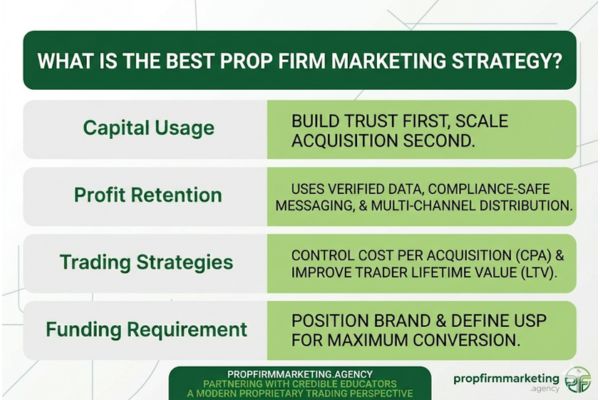
The best prop firm marketing strategy builds trust first and scales trader acquisition second. A strong prop firm marketing strategy uses verified data, compliance-safe messaging, and multi-channel distribution to control cost per challenge acquisition and improve trader lifetime value.
- Brand positioning and USP definition
- Conversion-focused website and funnel design
- Compliance-first messaging and claim validation (rules, payouts, pass rates)
- SEO and educational content marketing (guides, comparisons, knowledge base)
- Paid ads on Meta, Google, and YouTube (optimized for funded account funnel KPIs)
- Influencer, affiliate, and referral programs (partnering with credible educators)
- Community building on Discord and social platforms (retention and word-of-mouth)
- Email marketing automation (onboarding, nurture, reactivation, retention)
- PR and authority building (podcasts, trading media commentary, testimonials)
- Geographic expansion with localized campaigns (LATAM, MENA, Southeast Asia focus)
What are the main components of an Effective Prop Firm Marketing Strategy?
The main components of an effective prop firm marketing strategy combine trust building, compliant messaging, and measurable acquisition. An effective prop firm marketing strategy links brand credibility to scalable channels and retention systems.
- Unique selling proposition (USP) that differentiates rules, payouts, or trader support
- Credibility signals such as payout proof, verified testimonials, and public reviews
- Transparent offer structure that explains rules, pass rates, and payout terms
- Compliance-checked messaging that avoids unrealistic income claims and hype
- Professional website and conversion funnel with fast UX and clear onboarding
- Prop firm SEO and educational content targeting “funded trader program” search intent
- Community building through Discord, social groups, and active moderation
- Multi-channel acquisition using Meta ads, Google ads, YouTube, and influencers
- Email and lifecycle automation that nurtures leads and drives repeat purchases
- Performance tracking and optimization using KPIs like CPA, ROAS, and LTV
An effective prop firm marketing strategy improves acquisition efficiency and trader retention at the same time.
What are the steps to Implement an effective prop firm Marketing Strategy?
An effective prop firm marketing strategy follows a phased implementation roadmap. A phased roadmap builds credibility first, then scales acquisition, then improves retention and lifetime value.
- Set marketing goals and KPIs such as cost per challenge acquisition and repeat purchases.
- Define a clear USP and positioning that differentiates the funded trader program.
- Build a conversion-ready website that explains rules, payouts, and pass rates.
- Create a compliance-checked messaging framework that removes unrealistic income claims.
- Publish educational SEO content that answers real trader questions and objections.
- Launch paid acquisition campaigns on Meta, Google, and YouTube with funnel tracking.
- Build community and influencer partnerships with credible educators and streamers.
- Automate trader journeys using email sequences, onboarding, and progress reminders.
- Add trust signals and PR using podcast interviews, media coverage, and verified data.
- Track performance and optimize on a weekly basis using ROAS, conversion rates, and cohort retention.
What are the best tips for Prop Firm Marketers?
The best tips for prop firm marketers focus on trust, compliance, and measurable performance. Prop firm marketing performs best when messaging uses verified data and a multi-channel plan.
- Anchor marketing claims in verified data such as payouts, rules, and pass rates.
- Maintain strict compliance in every ad and landing page to reduce regulatory risk.
- Publish educational content for traders using blogs, webinars, tutorials, and platform guides.
- Build a professional onboarding journey that explains evaluation steps, payouts, and support.
- Diversify acquisition channels across SEO, email, Meta ads, Google Ads, and affiliates.
- Use community marketing for retention through Discord, Telegram, YouTube, and live sessions.
- Collaborate with credible trading educators and influencers who match the prop firm brand.
- Track prop firm marketing KPIs weekly using cost per challenge acquisition, repeat purchases, and community participation.
- Run A/B tests on creative and funnels to improve conversion rates and reduce CPA.
- Differentiate the prop firm offer with precision using skill-based evaluations, transparent rules, and founder credibility.
What are the things to avoid during a prop firm marketing campaign?
Prop firm marketing campaigns fail when messaging reduces trust or when channel choices waste budget. The most common prop firm marketing mistakes focus on compliance gaps, hype claims, and weak measurement.
- Promising unrealistic income, guaranteed profits, or “fast money” outcomes that cannot be verified.
- Publishing non-compliant ads that ignore local financial promotion rules and platform policies.
- Using vague challenge rules, unclear payout terms, or hidden fees that reduce transparency.
- Running bait-and-switch offers that differ from the landing page and checkout terms.
- Relying on paid ads as the only acquisition channel instead of SEO and content.
- Depending on one traffic source, such as Meta ads or influencer traffic.
- Launching campaigns without KPI tracking for cost per acquisition and funnel conversion rate.
- Skipping A/B testing for ad creatives, landing pages, and challenge pricing.
- Spending aggressively before building trust signals like testimonials and proof of payouts.
- Ignoring retention marketing, trader onboarding quality, and community engagement.
How to measure prop firm marketing campaign success
Prop firm marketing campaign success is measured by KPIs that connect marketing spend to challenge revenue, funded trader outcomes, and retention. Prop firm marketing teams track acquisition efficiency, trader quality, and profitability instead of vanity metrics like impressions.
- Cost per challenge acquisition (CPA/CAC): Measure ad spend per challenge purchase and compare by channel.
- Return on ad spend (ROAS): Divide tracked revenue by ad spend for each campaign.
- LTV-to-CAC ratio: Compare trader lifetime value against acquisition cost to confirm scalability.
- Funnel conversion rates: Track landing-page conversion, checkout completion, and pass-to-funded rates.
- Time to next monetization event: Measure time from first click to purchase, pass, or upgrade.
- Repeat purchase rate: Track the percentage of traders who buy another challenge.
- Funded traders and payout volume: Count funded accounts and total payouts to validate trader quality.
- Evaluation completion and dropout rate: Measure mid-challenge churn to find funnel leaks.
- Community participation rate: Track Discord activity, webinar attendance, and community engagement.
How to Improve your prop firm marketing
Improving prop firm marketing requires tighter targeting, higher trust signals, and continuous conversion-rate optimization. The most effective improvements focus on compliance, education, and retention because the prop trading market keeps getting more competitive and search interest keeps rising.
- Build a compliance-first messaging framework that removes unrealistic income claims and verifies every performance statement.
- Publish educational SEO content that targets “funded trader program” and challenge-related search intent.
- Improve offer transparency by listing rules, payouts, pass rates, and onboarding steps on key pages.
- Strengthen social proof with verified payout screenshots, video testimonials, and third-party review growth.
- Expand acquisition channels across SEO, Meta ads, Google Ads, YouTube ads, affiliates, and influencers.
- Run A/B tests on landing pages, checkout flows, and ad creatives to lower cost per challenge acquisition.
- Segment email marketing by trader stage to increase repeat purchases and customer lifetime value.
- Build a community hub on Discord or Telegram and moderate constant discussions and trader support threads.
- Add retention mechanics such as milestones, badges, and coaching pathways to reduce churn.
- Track KPIs that connect spend to revenue, including CAC, LTV, repeat purchase rate, and payout-to-revenue ratio.
- Align marketing budget with growth stage using phased spend ranges of €6k–€20k, €20k–€80k, and €80k–€250k+ per month.
- Expand geo-targeting into high-engagement regions such as LATAM, MENA, and Southeast Asia.
How to increase return on investment for prop firms
Increasing return on investment (ROI) for prop firms depends on measuring unit economics and reallocating spend toward predictable profit drivers. Prop firm marketing ROI improves when acquisition, conversion, and retention metrics stay connected to revenue outcomes.
- Track cost per challenge acquisition and cost-to-revenue ratio for each channel.
- Measure repeat purchase rate, time to next monetization event, and community participation rate.
- Align marketing budget with growth phase, using €6k–€20k per month for launch credibility.
- Scale budgets to €20k–€80k per month when community and influencer programs drive growth.
- Invest €80k–€250k+ per month when retention systems and leadership positioning exist.
- Shift budget from pure acquisition toward retention programs that reduce evaluation drop-off.
- Build SEO and educational content to lower customer acquisition cost over time.
- Anchor ad claims in verified data and keep messaging compliant to protect conversion rates.
- Diversify traffic sources across SEO, paid ads, influencers, and community to reduce volatility.
- Expand into high-engagement regions like LATAM, MENA, and Southeast Asia during scale.
What are the key elements of a successful prop firm marketing campaign?
A successful prop firm marketing campaign combines credibility, compliance, and measurable performance across the full trader lifecycle. Prop firm marketing campaigns win when the prop firm anchors payout and pass-rate claims in verified data, uses compliance-checked messaging for each region, and communicates challenge rules with clear transparency. Brand trust grows when a prop firm uses authority markers such as verified testimonials, professional onboarding, and consistent community engagement in Discord, social media, and ambassador programs. Conversion improves when prop firm marketing targets defined trader segments, diversifies acquisition across SEO, educational content, influencer partnerships, Meta ads, and Google ads, and optimizes campaigns using KPIs such as cost per challenge acquisition and repeat purchases. Retention protects profitability when a prop firm adds gamified trader journeys, coaching, competitions, and community participation loops that increase trader lifetime value.
How to build a successful prop firm brand
Building a successful prop firm brand requires credibility, differentiation, and consistent trader-facing execution. Prop firm branding works best when a prop firm proves transparency in rules, payouts, and pass rates.
- Define a clear brand position and trader persona
A prop firm brand position states who the prop firm serves and why. A trader persona defines experience level, preferred markets, and risk tolerance. - Create a unique value proposition backed by verifiable proof
A prop firm USP highlights one measurable advantage, such as evaluation design, payout speed, or platform experience. Verified data supports the prop firm USP with payout proofs, pass rates, and rule precision. - Build a professional digital foundation for trust and conversion
A prop firm website explains challenge rules, drawdown logic, payouts, and trader journey steps. A conversion-ready funnel uses clear landing pages, risk disclosures, and frictionless checkout. - Standardize compliance-checked messaging across every channel
Prop firm marketing copy avoids unrealistic income claims and vague guarantees. Compliance review aligns ad creatives, email sequences, and influencer scripts with local advertising rules. - Design challenge rules that reinforce brand fairness and sustainability
Prop firm challenge rules shape trader behavior and payout predictability. Data-driven thresholds and transparent automation reduce disputes and increase perceived legitimacy. - Publish credibility markers that reduce perceived scam risk
Credibility markers include verified testimonials, third-party reviews, and visible founder credentials. Media coverage and partner logos strengthen authority signals for new traders. - Build community and educational value for retention
A prop firm community uses Discord, live streams, and trade reviews to create belonging. Educational content answers trader questions on risk management, psychology, and evaluation strategy. - Scale brand reach with targeted acquisition and controlled partnerships
Influencer marketing works best with educators and traders who match the prop firm positioning. Paid ads on Meta, Google, and YouTube perform best with transparent funded-account funnels. - Measure brand strength using retention and repeat-purchase KPIs
Brand performance tracking uses cost per challenge acquisition, repeat purchases, and community participation rates. A prop firm brand improves when retention rises and disputes fall. - Iterate brand assets using feedback loops and analytics
Trader feedback identifies confusion points in rules, onboarding, and dashboards. A/B testing improves landing pages, ad creatives, and email onboarding sequences.
What are the best ways to build a prop firm brand?
The best ways to build a prop firm brand focus on trust, transparency, and a consistent trader experience. Prop firm marketing builds brand equity when a prop firm proves legitimacy with clear rules, verified outcomes, and compliant messaging in every channel.
A strong prop firm brand starts with a clear brand positioning statement. Brand positioning defines the target trader segment, the evaluation philosophy, and the main differentiation, such as skill-based evaluations or career-style progression programs.
A conversion-ready prop firm website strengthens brand credibility. A prop firm website needs plain-language pages for challenge rules, drawdown logic, payouts, pass rates, and platform conditions, because traders expect transparency in rules and payouts in a crowded 2026 market.
What are the things to avoid while building a prop firm brand?
Prop firm branding fails when prop firm marketing promises conflict with real trader outcomes. Prop firm owners protect brand trust by avoiding the pitfalls listed below.
- Promising guaranteed profits, “fast money,” or unrealistic income outcomes
- Publishing non-compliant marketing claims that ignore local regulations
- Hiding challenge rules, payout terms, pass rates, or refund conditions
- Using “unlimited” gimmicks such as unlimited time, retries, or scaling
- Setting challenge parameters from guesswork instead of trader data modeling
- Running bait-and-switch offers that change pricing or rules after signup
- Depending on one acquisition channel, such as Meta ads only
- Spending on paid ads without building SEO, education content, and community
- Using generic AI-only content that copies competitor positioning
- Using vague buzzwords instead of specific trader benefits and proof points
- Forcing influencer scripts that reduce authenticity and trader trust
- Prioritizing acquisition while neglecting retention, onboarding, and support
- Ignoring founder credibility signals, verified payouts, and transparent reporting
Who can help to improve your prop firm marketing?
Prop Firm Marketing Agency delivers the specialized prop firm marketing service described above. Prop Firm Marketing Agency helped one prop firm reach $3 million in profit in 9 months using data-driven campaigns, compliance-checked messaging, and performance optimization. Prop firm owners who want a measurable prop firm marketing plan can book a discovery call with Prop Firm Marketing Agency. A discovery call clarifies growth targets, channel priorities, and KPI reporting cadence.
Why choose Prop firm marketing agency for prop trading marketing?
A prop firm marketing agency improves prop trading marketing by using niche specialization, measurable KPIs, and multi-channel execution. Specialized support reduces compliance risk and improves trader acquisition efficiency.
-
Prop trading specialization and compliance control: A specialized prop firm marketing agency builds compliant messaging, transparent offers, and credibility signals that protect brand trust in a regulated niche. Source:
-
Data-driven performance and ROI tracking: A prop firm marketing agency tracks KPIs such as cost per challenge acquisition, repeat purchases, and community participation to turn marketing spend into predictable returns. Source:
-
Integrated growth across channels and lifecycle: A prop firm marketing agency combines SEO content, community building, influencer partnerships, and paid ads to support acquisition, onboarding, retention, and scaling. Source: